
Key facts
- A flatbed carrying roughly 120,000 pounds of construction equipment caught fire outside Pampa, Texas, leaving the trailer with no air and no lights.
- Recovery providers for this kind of incident are generally equipped for loads up to about 85,000 pounds, so no single provider could lift it.
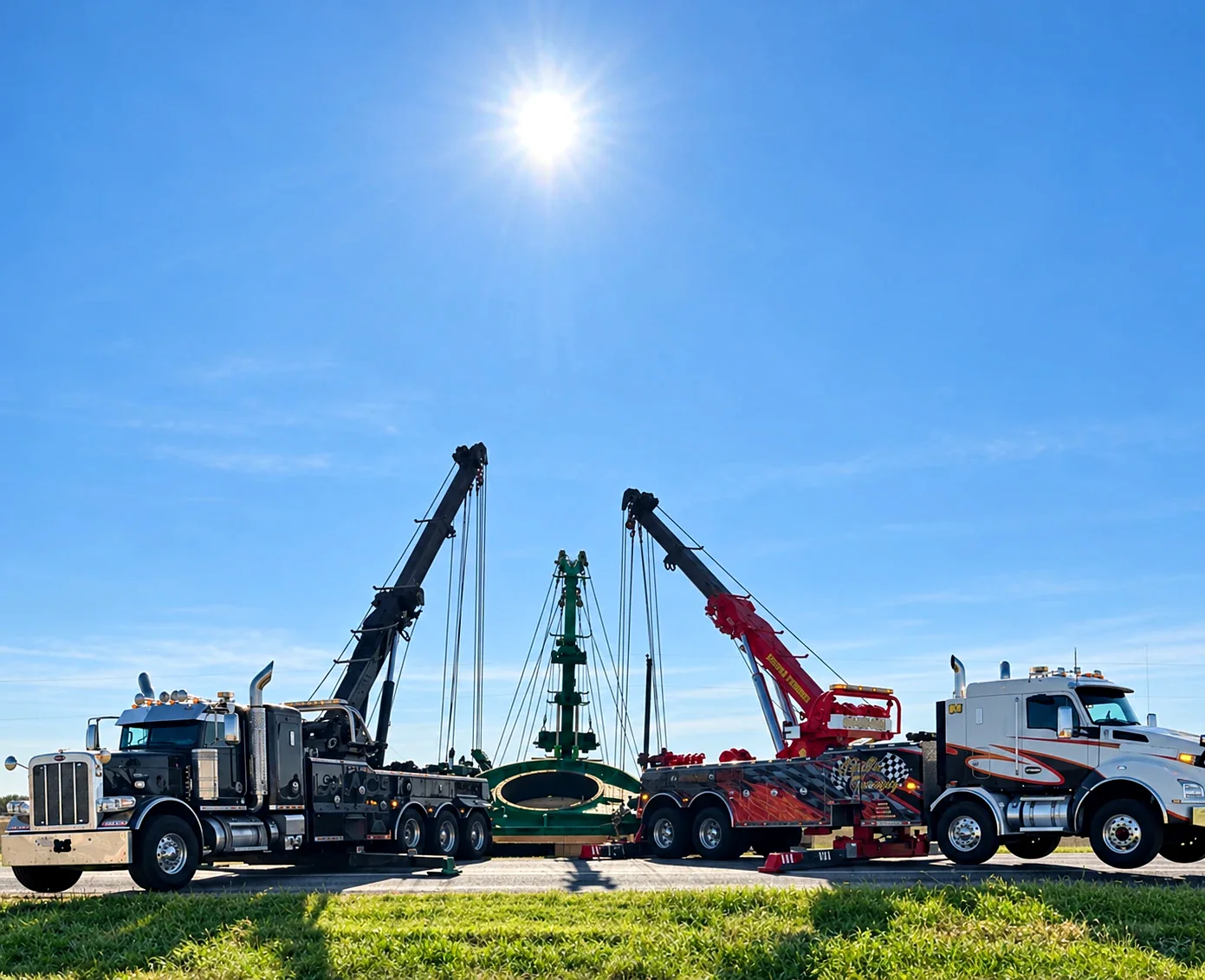
- WarehouseNow placed warning devices, briefed TXDOT and kept a safety vehicle on scene overnight. Three rotator cranes lifted the load at first light.
Most freight exceptions are solved by finding the right vendor. A rejected load needs a warehouse, a failed reefer needs a repair, a disabled tractor needs a tow. A smaller category has no single vendor at all. Resolving it means assembling several capabilities at once, under a regulatory clock, with liability growing by the hour. This paper looks at one of those cases.
A flatbed fire outside Pampa
A flatbed hauling a large piece of construction equipment caught fire on the road outside Pampa, Texas. The fire was put out, but the trailer was left completely disabled: no air, no lights, and no way to move, brake or be lit. On it sat a machine weighing approximately 120,000 pounds.
After the trailer went down, the driver left for a nearby truck stop. A disabled commercial vehicle and its load were now unattended on a public roadway, with no one there to warn traffic. WarehouseNow was called in to coordinate the response.
Two problems running at once
The compliance clock. Under the FMCSA rules for stopped commercial vehicles (49 CFR §392.22), hazard flashers are required immediately and warning devices must be placed within minutes. With its lights gone, this trailer could not meet either obligation on its own, and an unattended, unlit trailer is exactly the scene that gets examined after a collision.
The capacity ceiling. Recovery providers responding to this type of incident are generally equipped for loads up to roughly 85,000 pounds. This load was about 35,000 pounds past that. The answer was not a bigger version of the usual tow. It needed several heavy-recovery units working one lift together, with aligned rigging, a staged plan and daylight.
Securing the scene first
WarehouseNow moved on the scene before the freight. A team placed warning devices and restored visibility for oncoming traffic. TXDOT was contacted and briefed on the location and condition of the disabled unit. A safety vehicle stayed on scene through the night, so the load was never again sitting alone in the dark.
Three cranes, one lift
By daylight, a recovery involving three rotator cranes had been coordinated. Rigged to share the weight, the units lifted the machine clear and recovered it safely. The roadway was released and the freight was intact. The rigging plan, positioning, sequence and operators had all been settled overnight, so first light was when the work became visible, not when it began.
What Pampa demonstrates
WarehouseNow did not own a rotator, employ a lift operator or hold jurisdiction over a Texas highway. What it supplied was the missing piece: one party accountable for the whole problem.
- Secure before you solve. The recovery could wait for daylight. The compliance exposure could not.
- Know where the ceiling is. Conventional recovery has a weight limit, and heavy-haul freight can clear it. Finding that out at 2 a.m., one vendor at a time, is the most expensive way to learn it.
- Buy the coordination. When a problem spans several providers, the scarce resource is a single point of accountability that can assemble all of them at once.
Read the full white paper Download the PDF